
The AI visibility check reads one page of a website, its robots.txt file and its sitemap, then shows how ready the page is to be read and cited by ChatGPT, Perplexity, Claude and the AI features in Google. It runs 22 checks, grouped into four scores, and for each one it shows what it looked for and what it found.
Check a page
Working on it. Please keep this page open; the report appears here when the scan ends.
The check reads one page, its robots.txt and its sitemap, and usually finishes in under 15 seconds. Nothing is stored.
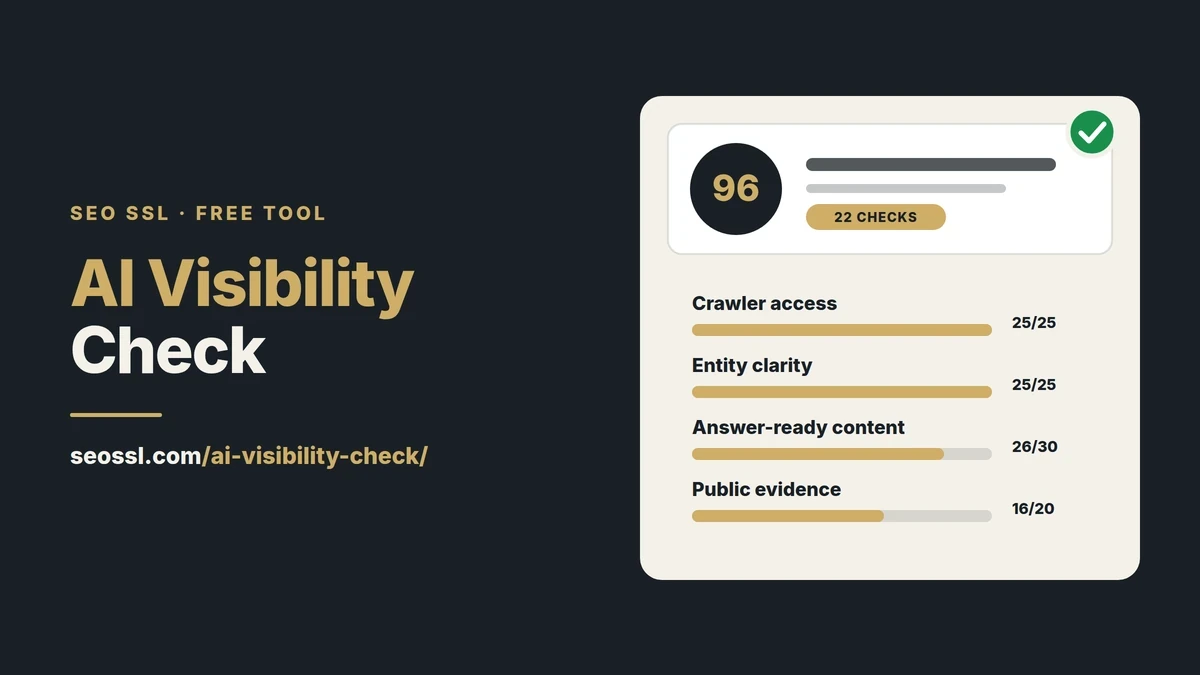
What each score checks
- AI crawler access (25 points). robots.txt rules for eight search crawlers and assistants, the response the server gives when a request carries the name of four AI crawlers, the XML sitemap, and noindex and nosnippet tags.
- Entity clarity (25 points). The title, the description, the H1 heading, structured data naming the business, public profiles and the About and Contact pages.
- Answer-ready content (30 points). How many words are in the initial HTML, whether there is a direct answer under the heading, sections phrased as questions, lists, tables and FAQPage structured data.
- Public evidence (20 points). The author, the date of the last update, concrete figures, links to sources and contact details.
Why the AI visibility check requests the page under a crawler name
The robots.txt file only states what you ask crawlers to do. A firewall or a protection service can reject an AI crawler even when robots.txt lets it in, and the site owner never finds out. We have seen this on sites protected by Cloudflare and by Imunify360.
So the tool requests the page four times, as OAI-SearchBot, ChatGPT-User, PerplexityBot and ClaudeBot, and compares the response with the one a browser receives. A different response is a signal to verify in your server logs: some protections also reject requests that merely carry the crawler name.
What Google and OpenAI say
According to the Google documentation on AI features, there are no extra technical requirements for AI Overviews and AI Mode: the page has to be indexed and eligible to be shown with a snippet. The foundation is still regular SEO, and the checks here come on top of it.
The OpenAI crawlers are described in the OpenAI documentation: OAI-SearchBot indexes for ChatGPT search, ChatGPT-User opens a page when a person asks, and GPTBot collects training data. Blocking GPTBot is a legitimate choice and is reported by the tool without affecting the score.
What the check cannot measure
It reads a single page and does not run JavaScript, as most AI crawlers do not. It cannot tell whether an assistant cites you for a given question, or what other websites say about your business. The score shows only how ready this page is to be read and cited.
For a wider review of your site, see the free SEO audit or our SEO services.