
The E-E-A-T audit reads up to 15 pages of a website and scores the trust signals that can be verified from the outside: who runs the site, whether the details agree from one page to the next, who writes the content and how well it is supported. The result is a score out of 100, with every check listed.
Check a website
Working on it. Please keep this page open; the report appears here when the scan ends.
The audit reads up to 15 public pages of the site and usually finishes in 10 to 60 seconds.
What E-E-A-T means
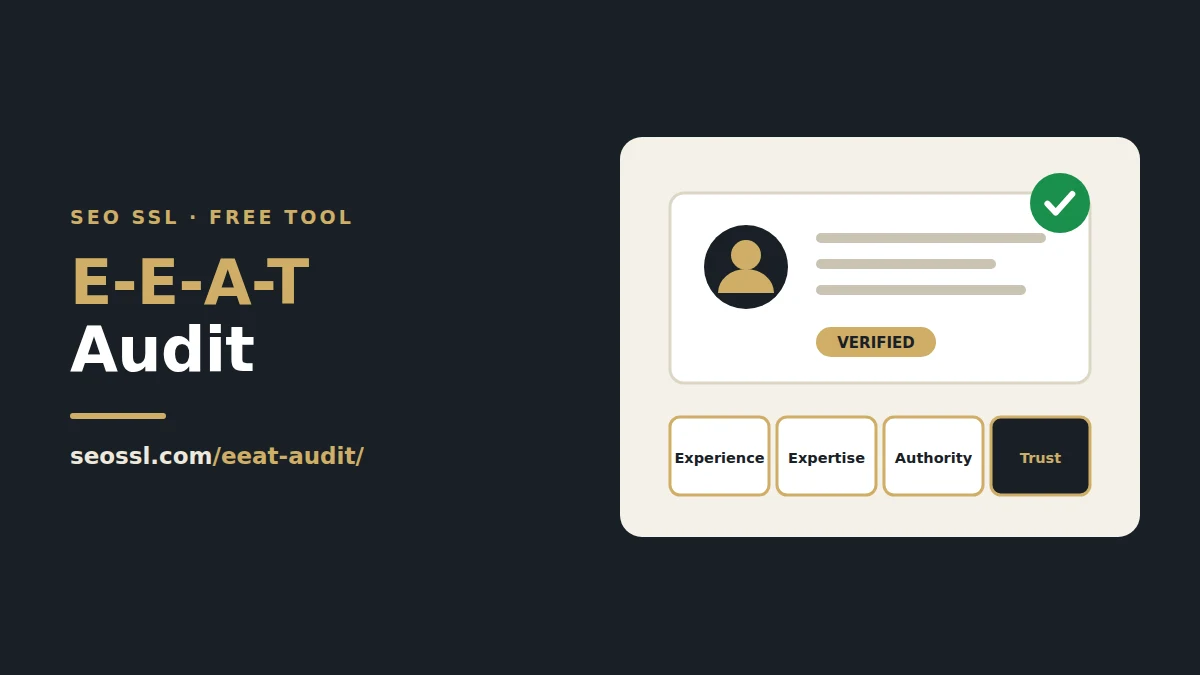
E-E-A-T stands for Experience, Expertise, Authoritativeness and Trust. The terms come from Google's Search Quality Rater Guidelines, the document human raters use when they evaluate search results. The guidelines place trust at the centre: a page that cannot be trusted has low E-E-A-T, however expert it looks.
E-E-A-T is not a single ranking factor and there is no official score. What a tool can do is check the signals a careful reader would look for, and report which ones are missing.
The four parts of the score
Identity, 40 points
Is the operator named, with its legal form? Is there a postal address, a phone number, an e-mail address, a privacy policy and terms? For companies registered in Romania the audit also validates the tax code by its check digit. For sites in other countries those registry checks are left out of the total, so they do not lower the score.
Consistency, 25 points
The audit compares the pages with each other. Two company names, two founding years or two phone numbers on the same site are contradictions that a scan of a single page cannot find.
Author, 20 points
Are articles signed by a named person? Does the name lead to an author page, and does that page state qualifications or experience?
Content, 15 points
Average length of the content pages, citations of authoritative external sources, and wording that shows first-hand experience.
Stricter rules for sensitive topics
Sites about health, money or legal matters fall under what Google calls Your Money or Your Life. If such a site scores under 60% on identity, the audit caps the total at 45 out of 100. This follows the rater guidelines: missing identity cannot be offset by good content.
What the audit cannot measure
Reputation, meaning what other people and other sites say about you, is the strongest E-E-A-T signal, and no tool can read it from your own pages. The report states this plainly and awards no points for it. A score of 100 means every signal the tool can verify is in place.
A part of the score that does not apply is removed from the total. A brochure site without a blog is not marked down for having no article authors.
Frequently asked questions
Which pages does the audit read?
The home page, the legal and contact pages it can find, the blog listing, a sample of articles and up to two author pages. The full list is at the bottom of each report.
Does a high score improve rankings?
Not by itself. The score shows whether the signals are present. Rankings also depend on content, links and competition, which this audit does not measure.
Why does the audit say my site has no address when it does?
The address may be inside an image, loaded by JavaScript after the page opens, or published only on a page the site does not link to. Search engines and AI crawlers read the same HTML the audit reads.
The E-E-A-T test is also part of the free SEO audit, next to five other tests.